

Who usually has the right of way in a lot
Parking lots mix slow cars, people on foot, shopping carts and drivers watching for a space instead of the lane. The law asks the question it asks anywhere: who failed to use ordinary care? In a lot, the answer usually follows a few patterns.
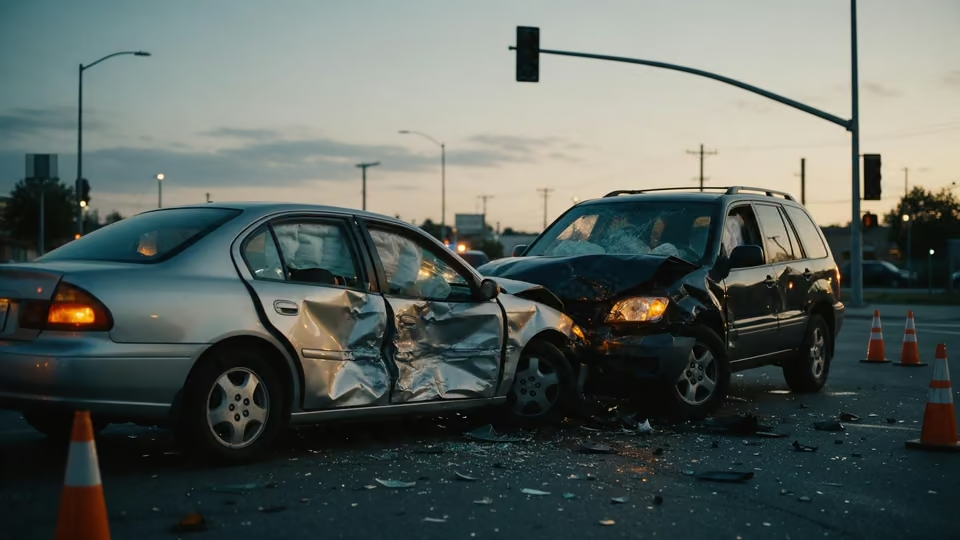
- Backing out of a space into a car in the through lane. The driver backing out usually has to wait until the lane is clear.
- Pulling out of a feeder lane into the main lane that runs along the stores. Traffic already in the main lane generally goes first.
- Cutting across empty spaces instead of using the lanes, or driving the wrong way down a one-way aisle.
- Speeding through the lot to catch a space or beat a light at the exit.
- Turning into a space across the path of a car coming the other way.
These are patterns, not rules written for every lot. Painted arrows, stop bars and signs are evidence of who should have yielded, even where a particular traffic rule does not reach private property, and witnesses or video usually decide the rest.
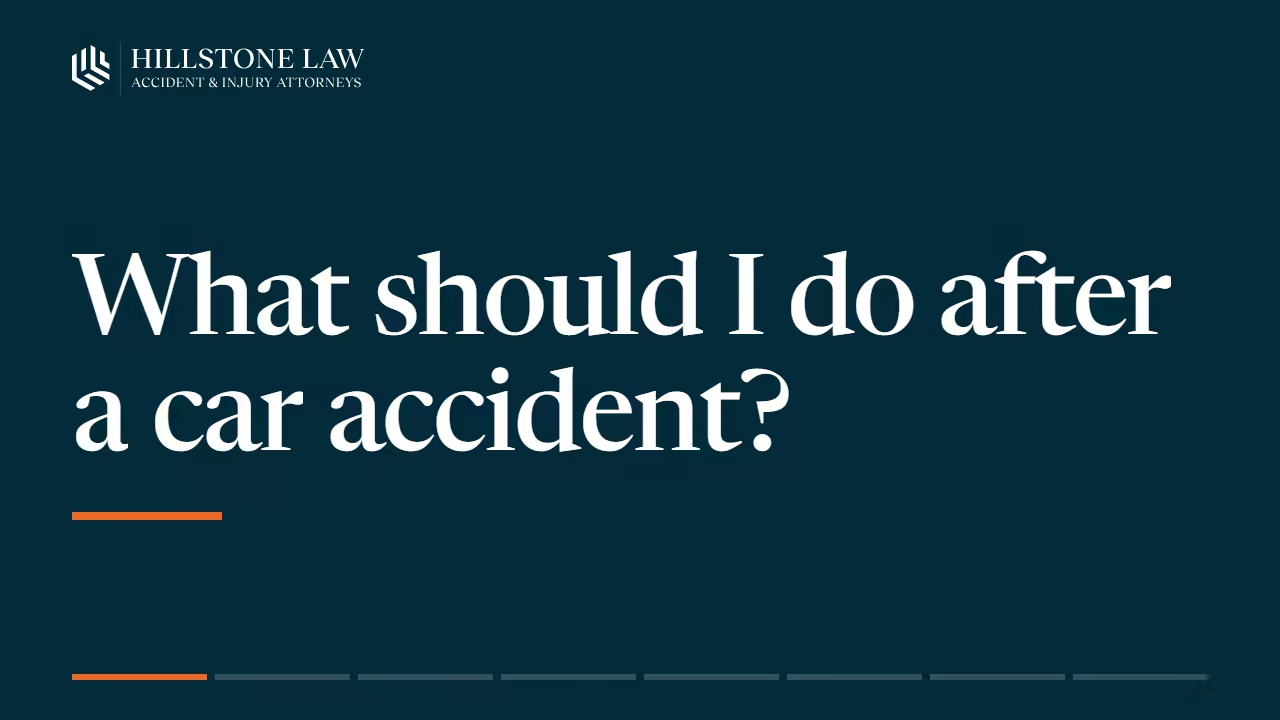
What should I do after a car accident in California?
Read the transcript
What should I do after a car accident in California?
What should I do after a car accident?
Stop. Check on everyone. Call 911 if anyone is hurt, even slightly.
Exchange information. Names, licence numbers, plates, insurers and policy numbers.
Photograph it. Find witnesses. The cars, the road, the signals, your injuries. Get names and phone numbers.
Say little about fault. Be polite, stick to facts, and do not guess about speed or distance.
See a doctor within days. Even if you feel mostly fine. Neck, back and head injuries often show up later.
10 days to report the crash to the DMV. When anyone was hurt, or damage was over $1,000. Form SR-1 · Vehicle Code 16000
Free consultation. Call and tell us what happened. (855) 691-1691 Hablamos español.
General information about California law, not legal advice for your situation.
Two cars backing out at once
The most common lot crash has no clear villain: two drivers reverse out of facing spaces and meet in the middle. Often both share the fault, because each had to check the way was clear. The shares depend on who was further out, who was moving, and what the video shows.
Shared fault does not end a claim in California. Your recovery is reduced by your share and never barred (Li v. Yellow Cab Co.). Where several people are at fault, each pays non-economic damages only in proportion to its own share (Civil Code 1431.2). Insurers like to call these crashes fifty-fifty by default; the evidence often says otherwise.
When the lot itself is to blame
A lot is private property, and its owner must use ordinary care too. Some crashes are partly the lot's fault:
- Faded or missing markings, so nobody can tell which way an aisle runs.
- A blind corner at the end of a row, with no mirror and a wall or a tall vehicle in the way.
- Broken lighting in a lot used at night.
- No stop sign or stop bar at a busy exit onto the street.
- Potholes and broken pavement that throw a car, a bike or a person.
When the condition of the lot contributed, the owner or the company that manages it may share responsibility, and its liability insurance may pay. Maintenance logs, complaints and earlier incidents are the proof, and the property company holds them.
If you were hurt in a fall in a lot, not in a crash, that is a premises claim. See parking lot injuries on someone's property.
Hit on foot between the cars
People on foot are part of every parking lot: walking to the store, loading a trunk, pushing a cart. Drivers must watch for them, especially near entrances and at the ends of rows where they step out between parked cars. Pedestrian injuries are rarely minor.
| Year | Crashes involving a pedestrian | People killed in them |
|---|---|---|
| 2022 | 12,467 | 1,206 |
| 2023 | 13,045 | 1,136 |
| 2024 | 13,487 | 1,125 |
Method: Statewide sums of the CCRS crash table, all reporting agencies and all locations, not parking lots alone; pedestrian crash as coded on the crash report; deaths are people killed in those crashes. CCRS undercounts where local police do not fully report, so each figure is a minimum. 2022–2024.
Source: California Highway Patrol (CCRS), read November 19, 2026.
Cite this: Crashes involving pedestrians reported in California, 2022-2024, Hillstone Law analysis of California Highway Patrol (CCRS) data, 2022–2024. https://hillstonelaw.com/personal-injury/auto-accidents/parking-lot-accidents/#data-pedestrian-crashes-california-2022-2024
These are statewide counts for every kind of location; the database figures in our packs do not separate parking lots, so we give no lot-only number and no ranking of the worst lots. Each figure is at least this many reported to the state crash database (CCRS), and local police under-report to it. A pedestrian hit in a lot has an injury claim against the driver's insurance, and the uninsured motorist coverage on a household car policy can cover a person on foot when the driver had too little. See pedestrian accidents.
If the other driver left
Lots are where drivers most often tap a car and leave. What you can claim depends on whether you were hurt and whether the driver can be found.
- You were hurt and the driver drove off. Your own uninsured motorist coverage can treat the unknown driver as uninsured, but it requires physical contact, a police report within 24 hours and a sworn statement to your insurer within 30 days (Insurance Code 11580.2). See hit-and-run claims.
- Only your parked car was damaged. That is a property claim, usually through your own collision coverage, minus the deductible. See property damage claims.
- A camera caught the plate. Then the claim goes against that driver's insurer like any other crash.
When a public agency runs the lot
Lots at city halls, libraries, parks, schools, transit stations and county hospitals are often run by public agencies. If the agency's lot design, lighting or a public vehicle played a part, a written government claim is due within 6 months (Government Code 911.2), long before the usual 2-year limit. Ask who owns the lot early; the sign at the entrance does not always say.
Who pays after a parking lot crash
| Source | When it applies |
|---|---|
| The at-fault driver's liability policy | First, for injuries and damage; minimum since 2025 is $30,000 per person and $60,000 per crash for injuries |
| The lot owner's or manager's liability insurance | When the lot's condition contributed |
| Your uninsured or underinsured motorist coverage | When the driver had no insurance, too little, or drove off after contact |
| Your collision coverage | Your car, minus the deductible, whoever was at fault |
| Your medical payments coverage | Medical bills up to its limit, whoever was at fault |
Method: Payment sources in the order insurers usually apply them; minimum limits from Vehicle Code 16056 for policies issued or renewed on or after January 1, 2025; uninsured motorist rules from Insurance Code 11580.2; owner's duty of care from Civil Code 1714. 2026.
Source: California codes (leginfo).
Cite this: Who can pay after a parking lot crash in California, Hillstone Law analysis of California codes (leginfo) data, 2026. https://hillstonelaw.com/personal-injury/auto-accidents/parking-lot-accidents/#data-parking-lot-payment-sources-2026
The minimums come from Vehicle Code 16056.
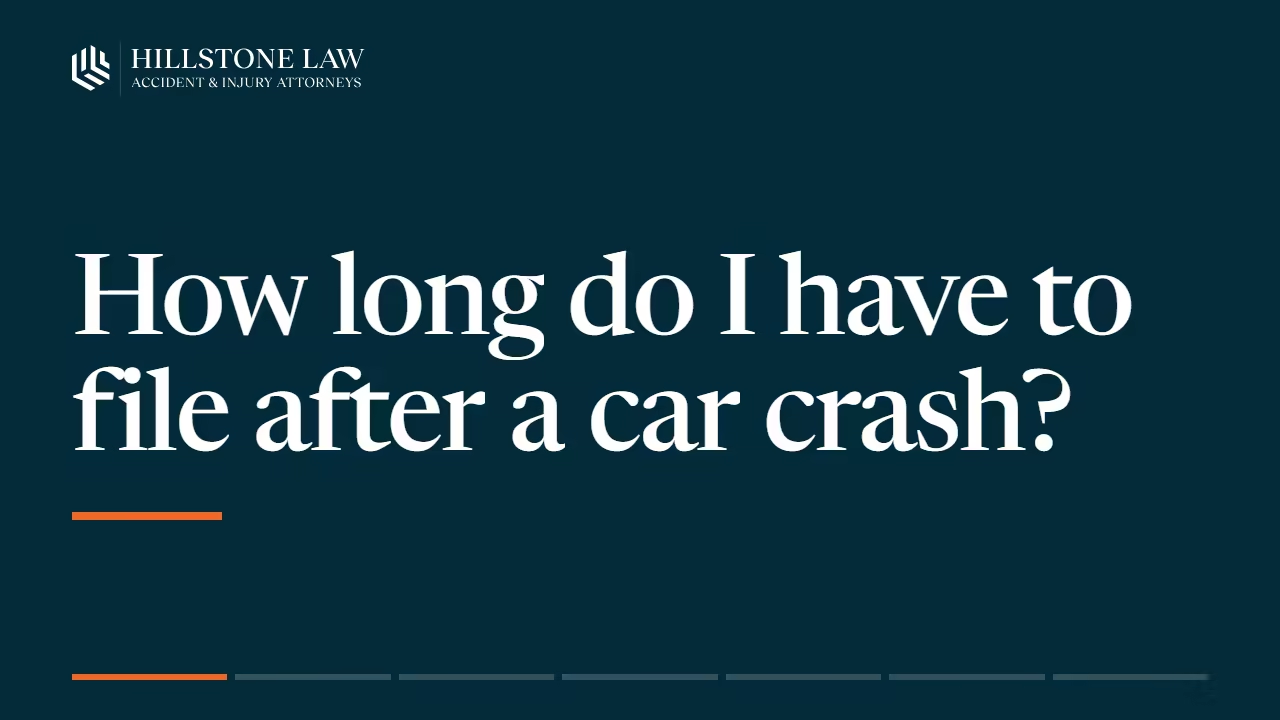
How long do I have to sue after a car crash in California?
Read the transcript
How long do I have to sue after a car crash in California?
How long do I have to file after a car crash?
2 years from the injury to file a lawsuit. That is the general deadline in California. Code of Civil Procedure 335.1
6 months if a public entity was involved. A city bus, a county truck, a dangerous public road: a written claim comes first. Government Code 911.2
The clocks that start at the crash: 10 days, dMV report, form SR-1; 6 months, claim against a public entity; 2 years, injury lawsuit; 3 years, vehicle damage only.
Negotiation does not stop the clock. If the claim is still open as the date approaches, the lawsuit must be filed to protect it.
Exceptions can shorten or extend these limits. A child was hurt; The at-fault driver died; A federal vehicle; Your own uninsured motorist claim.
Free consultation. Call and tell us what happened. (855) 691-1691 Hablamos español.
General information about California law, not legal advice for your situation.
Evidence the store and the lot hold
- Store and lot cameras. Most shopping centres record their lots, and most systems record over within days or weeks. Ask the store manager and the centre's management office right away, in writing.
- Lot markings and signs as they were that day: arrows, stop bars, crosswalks. Photograph them, because repainting changes them.
- Both cars' positions before they are moved, and the damage pattern, which shows which car was moving.
- Witnesses walking in the lot, and staff collecting carts.
- An incident report from the store or security company, if one was made.
The clocks after a parking lot crash
Some police agencies do not send an officer to a minor crash on private property. Call 911 when anyone is hurt and ask for a report or incident number; when nobody is, you can usually report it afterwards.
The DMV's SR-1 report is required within 10 days for crashes on a street or highway with injury or over $1,000 of damage (Vehicle Code 16000). Whether a private lot counts depends on the lot, so file it when you are unsure. The deadline to sue is 2 years for injuries (Code of Civil Procedure 335.1) and 3 years for vehicle damage (Code of Civil Procedure 338).
What to do before you leave the lot
- Check for injuries and call 911 if anyone is hurt.
- Photograph both cars where they stopped, the lane markings and any signs.
- Exchange names, licences, plates and insurance.
- Find the store manager and ask, in writing, for the lot video to be kept.
- Get witnesses' names and numbers.
- Note who owns or manages the lot; the management office is often on a sign at the entrance.
- See a doctor within days if anything hurts, even at a slow speed.
How we handle parking lot cases
- We send the video request to the store and the property manager before the footage is gone.
- We find out who owns the lot, private company or public agency, and whether its condition played a part.
- We answer the fifty-fifty offer with the video, the damage pattern and the witnesses.
- We deal with every insurer: the driver's, the lot owner's and your own.
You pay no fees unless you get paid. We answer 24 hours a day, 7 days a week. At your request, we can meet you at home or in the hospital. Our intake team speaks Spanish, and we work from 16 offices across California.
Results
We have no published result labelled parking lot. These are car accident results.
$1 million settlement
Injured in a car accident.
$899,000 settlement
Car crash, extensive treatment.
$500,000 policy-limits settlement
Car crash.
More on the case results page.
This is general information about California law, not legal advice for your situation.











