











The three conditions your own policy sets
Most hit-and-run claims are paid by the injured person's own insurer, not by the driver who left. California treats a vehicle whose owner and driver are unknown as an uninsured vehicle, but only when three conditions are met. Insurers check each one, and a claim that misses one can be refused even when the injuries are serious.
| Condition | What the law requires | Who usually handles it |
|---|---|---|
| Physical contact | The injury came from contact with the hit-and-run vehicle, either with you or with the car you were in | Shown by damage photos, the police report and the medical record |
| Police report | Reported within 24 hours to the city police, or outside a city to the sheriff or the local CHP office | You, a relative or anyone acting for you |
| Sworn statement | Filed with your insurer within 30 days, stating the facts and that the other driver is unknown | You, usually with your lawyer |
| Two-year rule | Within 2 years of the crash: agree the amount, sue the uninsured driver, or demand arbitration by certified mail | Your lawyer |
Method: Each condition is quoted in plain words from Insurance Code 11580.2, subdivisions (b) and (i), as read on leginfo on 2026-11-19. 2026.
Source: California codes (leginfo).
Cite this: Conditions for an uninsured motorist claim after a hit-and-run, Hillstone Law analysis of California codes (leginfo) data, 2026. https://hillstonelaw.com/personal-injury/auto-accidents/hit-and-run-accident-lawyers/#data-hit-and-run-um-conditions-2026
The contact rule is the one people do not expect. A driver who forces you off the road and never touches your car leaves you without this coverage, so it matters to photograph every scrape and paint transfer that shows the vehicles met. The report rule is forgiving about who makes it: the law accepts a report made by "someone on his or her behalf", so a family member can call while you are in the emergency room.
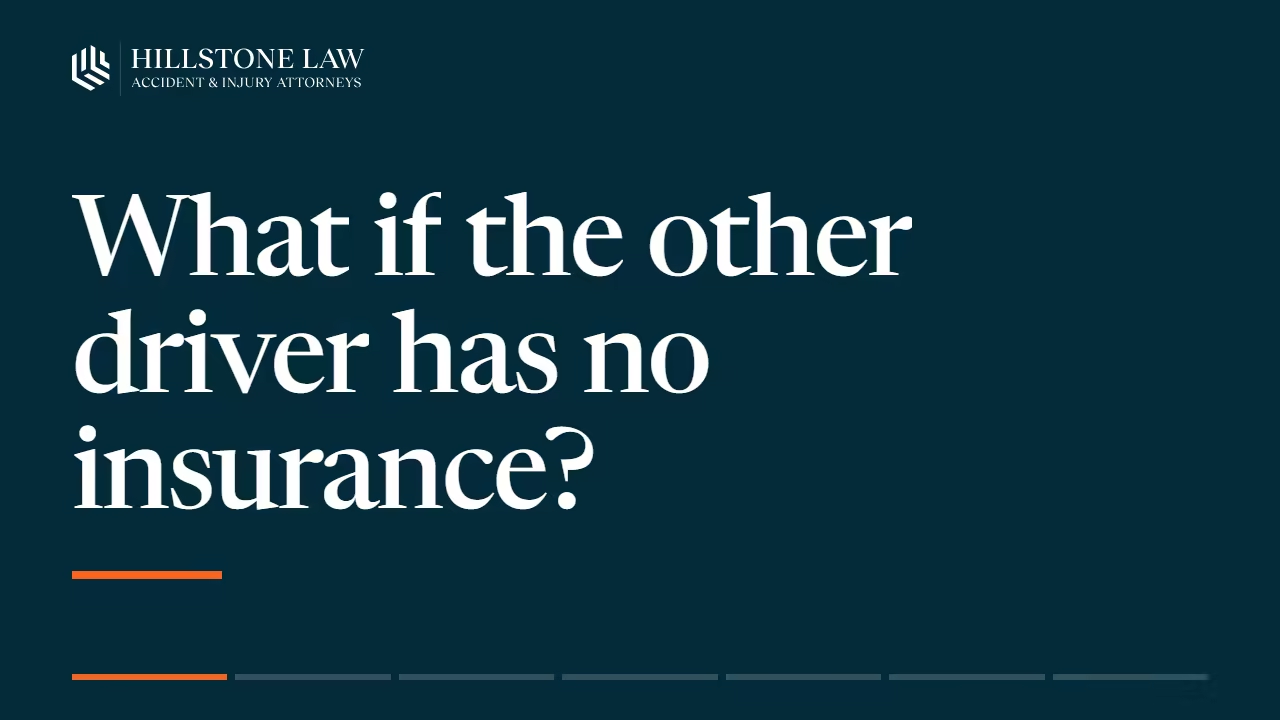
What if the other driver has no insurance in California?
Read the transcript
What if the other driver has no insurance in California?
What if the other driver has no insurance?
Your own policy usually pays. Uninsured motorist coverage, up to your limits.
It is in your policy unless you deleted it in writing. California requires insurers to include it. Insurance Code 11580.2
2 years to sue, agree the amount or demand arbitration. Counted from the crash. If none happens, the claim is lost. Insurance Code 11580.2
If the driver drove off: Police report within 24 hours; Sworn statement to your insurer within 30 days.
Get your insurer's consent before settling. Settling with anyone else without it can cost you the claim.
Free consultation. Call and tell us what happened. (855) 691-1691 Hablamos español.
General information about California law, not legal advice for your situation.
How often drivers flee in California
Leaving the scene is common, not rare. Of all crashes reported to the state crash database, about one in four involves a driver who left, and roughly one in eleven crashes that hurt or killed someone is a hit-and-run.
| Year | All crashes reported | Hit-and-run crashes | Crashes that hurt or killed someone | Hit-and-run crashes that hurt or killed someone |
|---|---|---|---|---|
| 2022 | 405,239 | 101,922 | 163,897 | 14,500 |
| 2023 | 409,836 | 102,420 | 167,358 | 14,512 |
| 2024 | 417,173 | 103,184 | 171,977 | 15,073 |
Method: Statewide sums of the CCRS crash table, all reporting agencies; hit-and-run as coded on the crash report; each hit-and-run count sits beside the total it belongs to, so the share can be read across the row. CCRS undercounts where local police do not fully report, so each figure is a minimum. 2022–2024.
Source: California Highway Patrol (CCRS), read November 19, 2026.
Cite this: Hit-and-run crashes reported in California, 2022-2024, Hillstone Law analysis of California Highway Patrol (CCRS) data, 2022–2024. https://hillstonelaw.com/personal-injury/auto-accidents/hit-and-run-accident-lawyers/#data-hit-and-run-crashes-california-2022-2024
Those are minimums: each figure is at least this many reported to the state crash database (CCRS), and local police under-report to it. The steady numbers carry a practical lesson. Insurers handle unknown-driver claims every week, they know the three conditions by heart, and they will ask for proof of each one. For crash figures across the state, see California accident statistics.
Who is liable when the driver is never found
The driver who fled is liable, and so is the owner of the car if the driver used it with permission. Leaving does not erase the case. It makes the driver harder to find, and it is a crime: a driver involved in a crash that injures someone must stop, give their information and help (Vehicle Code 20001). Fleeing an injury crash can mean state prison and a fine of $1,000 to $10,000, and 2, 3 or 4 years in state prison when someone is killed or permanently, seriously hurt.
Three paths follow from that.
- The driver is identified, by police, a camera or a witness who caught the plate. The case becomes an ordinary injury claim against that driver and their insurer, and the flight itself is strong evidence of guilt.
- The driver is never identified. The claim moves to your own policy's uninsured motorist coverage, under the three conditions above.
- The driver is found but has no insurance, or too little. The same uninsured and underinsured motorist coverage fills the gap up to your limits.
Sometimes someone else shares the blame: an employer whose delivery van left the scene, or a city that left a dangerous road condition. A claim against a public agency has its own 6-month deadline (Government Code 911.2), so it is worth checking early.
Hit while walking, cycling or riding
Many of the people hurt by drivers who leave were not in a car at all. California's uninsured motorist coverage protects the policyholder, a spouse and relatives who live in the same household "while occupants of a motor vehicle or otherwise", so the coverage on the family car can follow you onto the sidewalk.
- On foot. A pedestrian struck in a crosswalk or a parking lot can claim on their own car policy, or on the policy of a relative they live with. Contact is easy to show: the injury itself is the proof. See pedestrian accidents.
- On a bicycle or scooter. The same household coverage can apply. Keep the damaged bike as it is; a bent wheel or a scraped frame is evidence of contact. See bicycle accidents.
- On a motorcycle. Read the motorcycle policy first: whether it carries uninsured motorist coverage, and its limits, decide the first claim. A car policy in your household may add more. See motorcycle accidents.
- Hit by a truck that kept going. Big rigs sometimes clip a car and never notice, or never stop. Write down the company name, the colours and any numbers painted on the cab or trailer; carriers can be traced from far less. See truck accidents.
If you live alone with no car policy of your own and nobody in your household has one, this coverage may not exist for you. Other routes can remain: the driver if police find them, or a liable business or agency.
Who pays, and what the claim does not cover
For most people the answer is their own auto policy. California insurers must include uninsured motorist coverage in every auto liability policy unless the policyholder deleted it in writing, so many people have it without knowing. Passengers in an insured car are covered too.
Two limits catch people out. First, uninsured motorist coverage under this law does not pay for damage to your car; collision coverage, if you bought it, handles that. Second, settling with anyone else who may be liable without your insurer's written consent can forfeit the claim, so talk to us before you sign anything. If you were driving your own car without insurance yourself, California law also bars your claim for pain and suffering against the other driver, though medical bills and lost wages remain (Civil Code 3333.4).
Will a claim raise your premium? Ask your insurer how it treats a crash you did not cause, but do not let the 30 days run out while you decide. Missing the sworn statement to protect a premium can cost the claim for good.
Evidence that can still name the driver
In a hit-and-run, two facts are the case: who the driver was, and that the vehicles touched. The proof of both disappears fast.
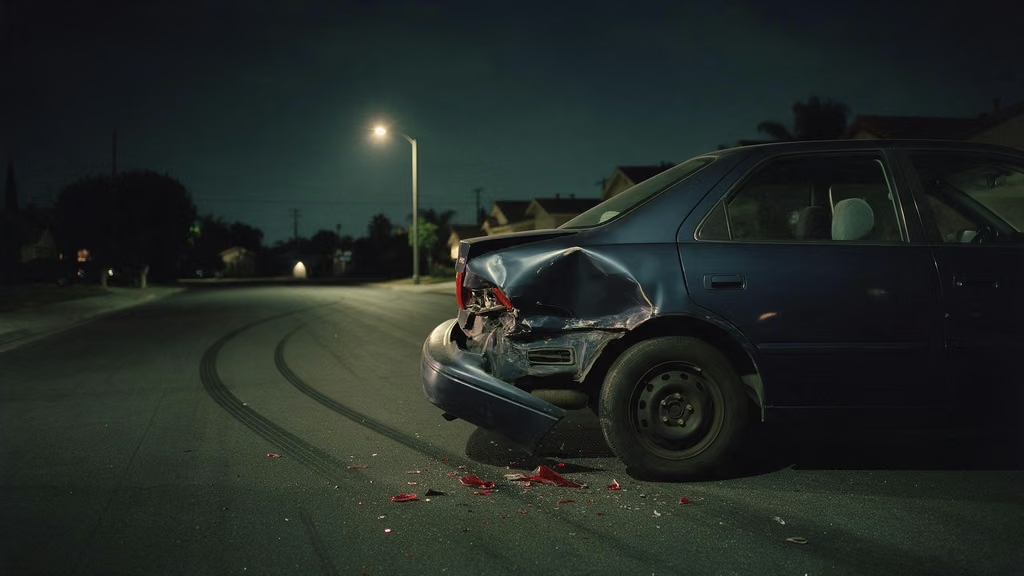
- Video. Business cameras, doorbells, buses and traffic cameras often record over within days or weeks. Ask early, in writing, for footage to be kept.
- Paint, glass and parts left at the scene. Photograph them and tell the police; a piece of a grille or a mirror housing can point to a make, model and colour.
- The damage to your car or bike. It shows contact, which the insurer will ask about. Do not repair it before it is photographed from every side.
- Witness names and plates. A partial plate is often enough for police to search.
- The police report. The agency must release it to anyone with a proper interest, including the people involved and their lawyers (Vehicle Code 20012). It also proves the 24-hour report your insurer will check.
If the driver is found weeks later, the same evidence ties them to the crash. If they never are, it proves the contact your own policy requires.
Your first 30 days, in order
- Now: call 911 or get medical care first, and tell the doctor everything that hurts.
- Within 24 hours: report the crash to the police, or have someone do it for you. Note the report number and the agency.
- The same day: write down the colour, make, damage, direction and any part of the plate, and photograph the scene, the debris, your vehicle and your injuries.
- This week: ask nearby businesses and neighbours to keep their video, in writing.
- Within 10 days: file the DMV SR-1 when anyone was hurt or damage passed $1,000 (Vehicle Code 16000).
- Within 30 days: give your insurer the sworn statement for the uninsured motorist claim, and keep a copy.
- Every week after: keep bills and records of missed work. The injury lawsuit deadline is 2 years (Code of Civil Procedure 335.1), and it runs even while the police are still looking.
What a lawyer does when the driver is gone
- We meet the two clocks. We check that the 24-hour report exists and prepare the sworn statement before day 30.
- We look for the driver. We send video preservation requests to businesses near the scene and follow the police investigation.
- We deal with your insurer. Your own company becomes the other side in an uninsured motorist claim; every call and letter goes through us.
- We look past your policy. An employer, a vehicle owner or a public agency may also be responsible.
You pay no fees unless you get paid. We answer 24 hours a day, 7 days a week. At your request, we can meet you at home or in the hospital, or by video. Our whole team speaks Spanish, and we work from 16 offices across California.
Results
We have no published result labelled hit-and-run. These are car accident results.
$1.97 million settlement
Car crash, catastrophic injury.
$1 million settlement
Injured in a car accident.
$500,000 policy-limits settlement
Car crash.
More on the case results page.
This is general information about California law, not legal advice for your situation.

