

When a motorcycle lawsuit makes sense
- The insurer blames the rider: speed, lane splitting, visibility, or no helmet.
- The injuries are serious and the offer leaves out future surgery, therapy or lost earning power.
- Several parties may share fault, such as a driver, the driver's employer, a public agency or a parts maker, and they each point at the others.
- The deadline is close. Filing stops the clock while talks continue.
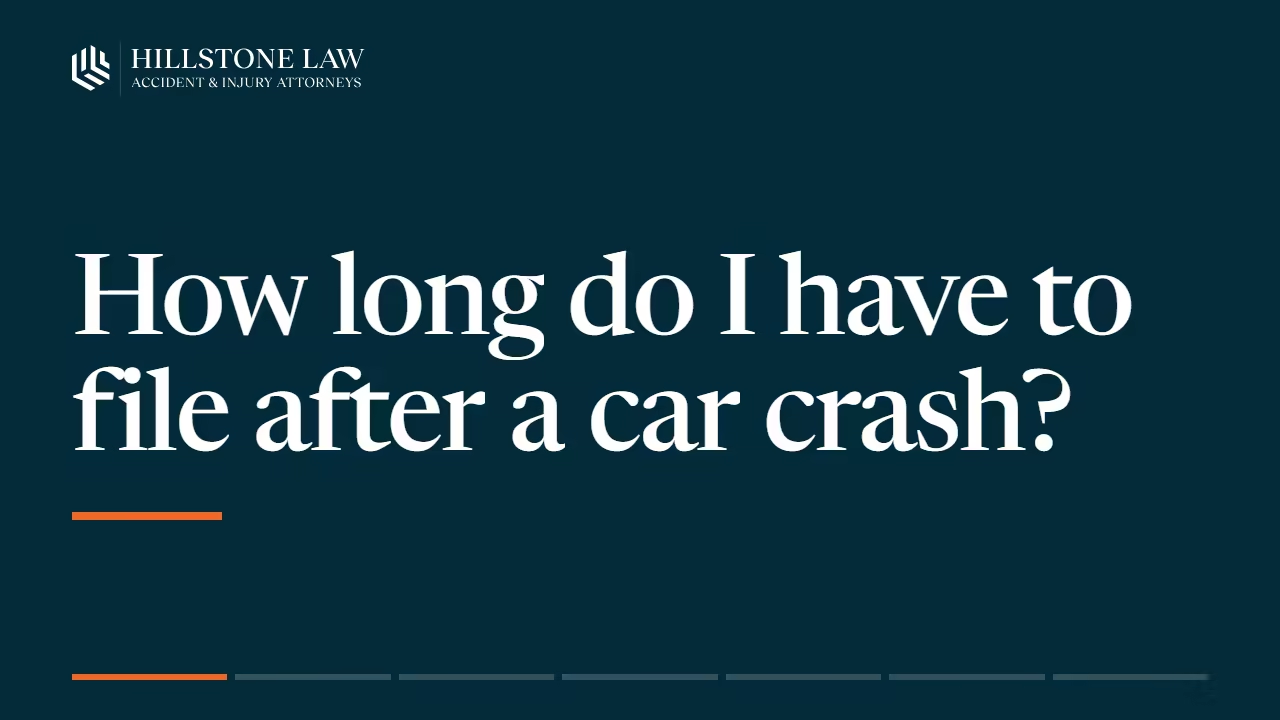
How long do I have to sue after a car crash in California?
Read the transcript
How long do I have to sue after a car crash in California?
How long do I have to file after a car crash?
2 years from the injury to file a lawsuit. That is the general deadline in California. Code of Civil Procedure 335.1
6 months if a public entity was involved. A city bus, a county truck, a dangerous public road: a written claim comes first. Government Code 911.2
The clocks that start at the crash: 10 days, dMV report, form SR-1; 6 months, claim against a public entity; 2 years, injury lawsuit; 3 years, vehicle damage only.
Negotiation does not stop the clock. If the claim is still open as the date approaches, the lawsuit must be filed to protect it.
Exceptions can shorten or extend these limits. A child was hurt; The at-fault driver died; A federal vehicle; Your own uninsured motorist claim.
Free consultation. Call and tell us what happened. (855) 691-1691 Hablamos español.
General information about California law, not legal advice for your situation.
Who is named
| Party | When |
|---|---|
| The driver | Whenever the driver caused or helped cause the crash |
| The vehicle owner | If someone else owned the car (Vehicle Code 17150) |
| The driver's employer | If the driver was working |
| A public agency | For a dangerous road condition, such as a pothole, gravel or a broken signal (Government Code 835); a written claim to the agency is due within 6 months first (Government Code 911.2) |
| A motorcycle or parts maker | For a failed brake, tyre or other defect |
| "Doe" defendants | Parties whose names are not yet known, added once found (Code of Civil Procedure 474) |
Each defendant pays only its own share of non-economic damages such as pain and suffering (Civil Code 1431.2), so every responsible party should be named.
The fight over fault
Motorcycle lawsuits often turn on the rider's conduct more than other crash cases do. Expect the defence to argue:
- Speed. Answered with video, vehicle data, the damage and the scene.
- Lane splitting. State law defines it (Vehicle Code 21658.1); it does not make a crash the rider's fault by itself.
- Visibility. The most common motorcycle crash is a driver turning left across a rider's path, and that driver must yield to oncoming traffic close enough to be a hazard (Vehicle Code 21801). "I did not see him" is an admission, not a defence.
- No helmet. Riders must wear one (Vehicle Code 27803); the argument can only reduce damages for injuries a helmet would have prevented.
Any share of fault proven against the rider reduces the recovery; it does not bar it (Li v. Yellow Cab Co. (1975) 13 Cal.3d 804).
How juries see riders
Some jurors start with a view of motorcyclists as risk-takers. A motorcycle case is prepared with that in mind: the rider's training, experience and gear, the rider's ordinary life and work, and clear evidence of what the driver did. Jury selection lets both sides ask potential jurors about their views of motorcycles, and either side can ask for a jury (Code of Civil Procedure 631).
How the case moves
- Complaint and service in the superior court, usually in the county where the crash happened.
- Answers from each defendant, usually through lawyers paid by their insurers.
- Discovery: records, sworn testimony, inspection of the motorcycle and the other vehicle, and the exchange of expert witnesses, such as accident reconstructionists and doctors (Code of Civil Procedure 2034.210).
- Offers and mediation. A formal settlement offer can shift costs if it is refused and beaten at trial (Code of Civil Procedure 998). Most motorcycle cases settle here.
- Trial, which must begin within 5 years of filing (Code of Civil Procedure 583.310).
Your own testimony
In a motorcycle lawsuit, the rider usually gives a deposition: sworn answers to the defence lawyer's questions, recorded by a court reporter. The questions cover the ride, the speed, the gear, earlier riding history, and life before and after the crash. Preparation matters, because the defence will use any loose estimate of speed or distance against the rider. Riders who kept a ride log, camera footage or training records find this step easier. We prepare you for it in advance, and we attend with you.
How much does a personal injury lawyer cost in California?
Read the transcript
How much does a personal injury lawyer cost in California?
How much does a personal injury lawyer cost?
No fees unless you get paid. Our fee comes only from what we recover for you.
What you pay along the way: Nothing to hire us; Nothing while the case is open; Nothing by the hour.
A percentage of the recovery, in writing. You sign the agreement before we start. California law does not set the percentage. It is negotiable. Business and Professions Code 6147
Before you sign a settlement, we go through it line by line. The gross amount; Our fee; Each lien; What you receive.
Free consultation. Call and tell us what happened. (855) 691-1691 Hablamos español.
General information about California law, not legal advice for your situation.
Keep the motorcycle
The motorcycle is evidence. Its damage shows the angle and force of impact, and a defect claim depends on it. Do not let it be repaired, sold or scrapped until it has been inspected, and keep the helmet and gear too.
What it costs you
No fees unless you get paid. A court can order a losing party to pay the other side's court costs (Code of Civil Procedure 1032); we explain that risk before any lawsuit is filed.
Results
$4,725,000 settlement
Motorcycle crash, Los Angeles County, 2025 · Obtained with co-counsel.
What we do for you at this step
We keep the motorcycle, the helmet and the scene evidence, name every responsible party, prepare the case for the jury's questions about riders from the start, and keep every deadline. We answer 24 hours a day, 7 days a week. Our intake team speaks Spanish. At your request, we can meet you at home or in the hospital.











