

Why a case is prepared for a jury
Only a small share of injury lawsuits are decided by a jury. Most settle, often after depositions or shortly before trial, when both sides can see the evidence clearly. We still prepare every case as if it will be tried, because the questions a jury would ask are the ones that decide its value: who was at fault, what the injury cost, and what the evidence proves. A case ready for trial is one where those answers are already on paper. Whether it settles is always your decision.
How long do I have to sue after a car crash in California?
Read the transcript
How long do I have to sue after a car crash in California?
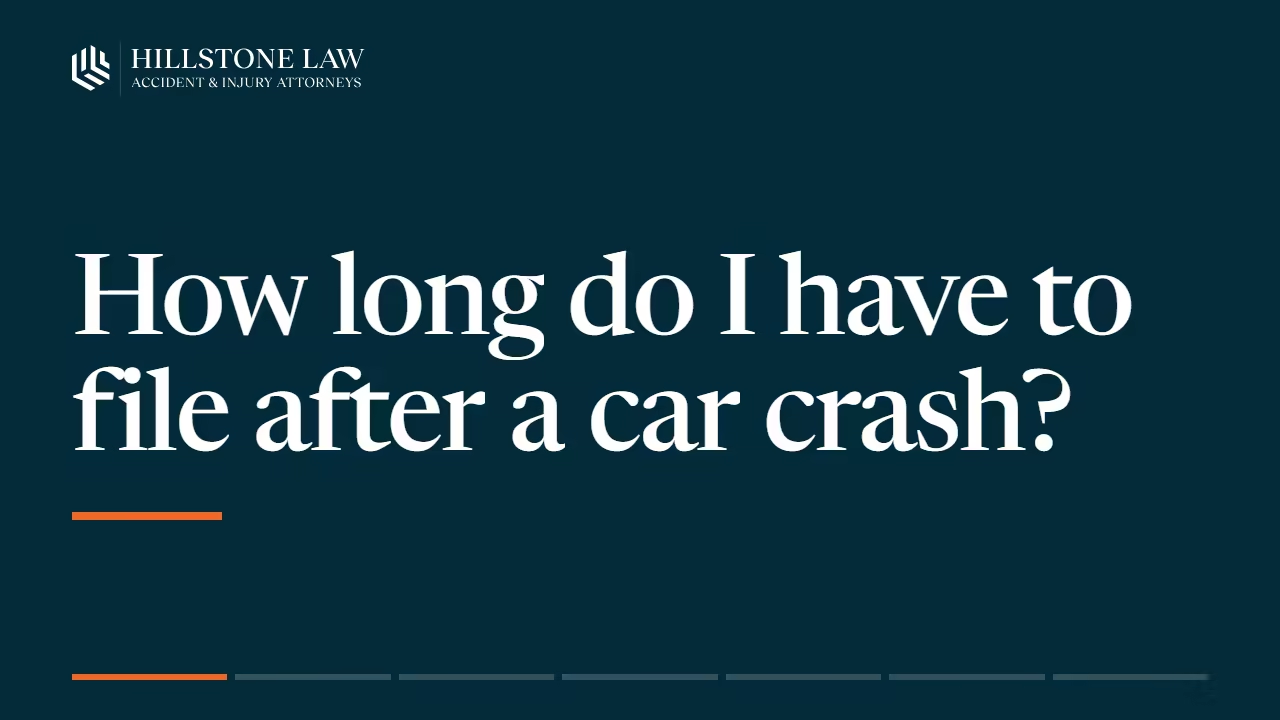
How long do I have to file after a car crash?
2 years from the injury to file a lawsuit. That is the general deadline in California. Code of Civil Procedure 335.1
6 months if a public entity was involved. A city bus, a county truck, a dangerous public road: a written claim comes first. Government Code 911.2
The clocks that start at the crash: 10 days, dMV report, form SR-1; 6 months, claim against a public entity; 2 years, injury lawsuit; 3 years, vehicle damage only.
Negotiation does not stop the clock. If the claim is still open as the date approaches, the lawsuit must be filed to protect it.
Exceptions can shorten or extend these limits. A child was hurt; The at-fault driver died; A federal vehicle; Your own uninsured motorist claim.
Free consultation. Call and tell us what happened. (855) 691-1691 Hablamos español.
General information about California law, not legal advice for your situation.
The road to trial
| Stage | What happens |
|---|---|
| Lawsuit filed | The complaint is filed and served; the defendant answers, usually through the insurer's lawyers |
| Written discovery | Each side asks the other written questions and requests documents |
| Depositions | Witnesses answer questions under oath, with a court reporter recording every word |
| Medical examination | The defense may ask a doctor of its choice to examine the injured person |
| Trial date set | The court sets the date at a case management conference |
| Expert witness exchange | After the trial date is set, either side can demand that both sides name their expert witnesses at the same time (Code of Civil Procedure 2034.210) |
| Mediation | A neutral mediator meets both sides to try to settle |
| Final preparation | Exhibits, witness lists and motions about what evidence the jury may hear |
Method: Stages in their usual order in a California superior court; the rows that cite a section follow that section, the others describe general practice and their order can vary by court. 2026.
Source: California codes (leginfo).
Cite this: The stages of a California injury lawsuit before trial, Hillstone Law analysis of California codes (leginfo) data, 2026. https://hillstonelaw.com/guides/personal-injury-trial/#data-ca-pi-pretrial-stages-2026
A case must be brought to trial within 5 years after it is filed (Code of Civil Procedure 583.310). Most injury cases reach a trial date well before that.
Your deposition
A deposition is the defense lawyers' chance to hear your account under oath before trial. It usually takes place in a lawyer's office or by video, with your lawyer beside you and a court reporter recording every word. The answers can be read to the jury later, so preparation matters.
| Part of the day | What to expect |
|---|---|
| Before it starts | We meet with you beforehand, explain the kinds of questions to expect and go through the records together |
| The oath | The court reporter swears you in, just as in court |
| Background | Where you live and work, your schooling, your health before the accident |
| The accident | How the crash or fall happened, step by step, and what you saw and heard |
| Injuries and treatment | Every doctor, every symptom, what has improved and what has not |
| Work and daily life | Time off, tasks you can no longer do, how your days changed |
| Afterwards | You can review the transcript for errors in what was recorded |
The rules are simple: listen to the whole question, pause before you answer, answer only what is asked, and say so when you do not know or do not remember. Do not guess, and do not try to argue your case: that is your lawyer's job at trial. A car crash deposition and a fall deposition follow the same pattern; only the accident questions change.
The jury and its fee
In California, the right to a jury in a civil case is preserved, and a jury can be waived only in the ways the statute lists (Code of Civil Procedure 631). Each side that wants a jury pays a nonrefundable jury fee of $150, due on or before the first case management conference. A party that does not pay on time can lose the right to a jury.
Inside the courtroom
- Jury selection. Potential jurors are questioned by the judge and the lawyers, who can ask that some be excused. The goal is a fair jury, not a friendly one.
- Opening statements. Each side tells the jury what it expects the evidence to show.
- The injured person's case. Witnesses testify: the injured person, people who saw the crash, family members, treating doctors and expert witnesses such as accident reconstructionists and economists. The defense cross-examines each one.
- The defense case. The defense calls its own witnesses, including expert witnesses, often to argue that the injured person was partly at fault or that the injuries are less serious than claimed.
- Closing arguments. Each side explains how the evidence answers the questions the jury must decide.
- Instructions and deliberation. The judge explains the law. The jury then deliberates in private.
- Verdict. The jury answers written questions: was the defendant negligent, did it cause the harm, did the injured person share fault, and what are the damages.
In a civil case the injured person must prove the claim by the greater weight of the evidence: more likely true than not. That is a lower standard than in a criminal case.
What a jury decides about damages
The jury sets an amount for each kind of loss: past and future medical care, past and future lost earnings, and non-economic harm such as pain, emotional distress and the loss of enjoyment of life. If the injured person shares fault, the award is reduced by that share (Li v. Yellow Cab Co. (1975) 13 Cal.3d 804). Where several defendants are at fault, each pays only its own share of the non-economic damages (Civil Code 1431.2).
How much does a personal injury lawyer cost in California?
Read the transcript
How much does a personal injury lawyer cost in California?
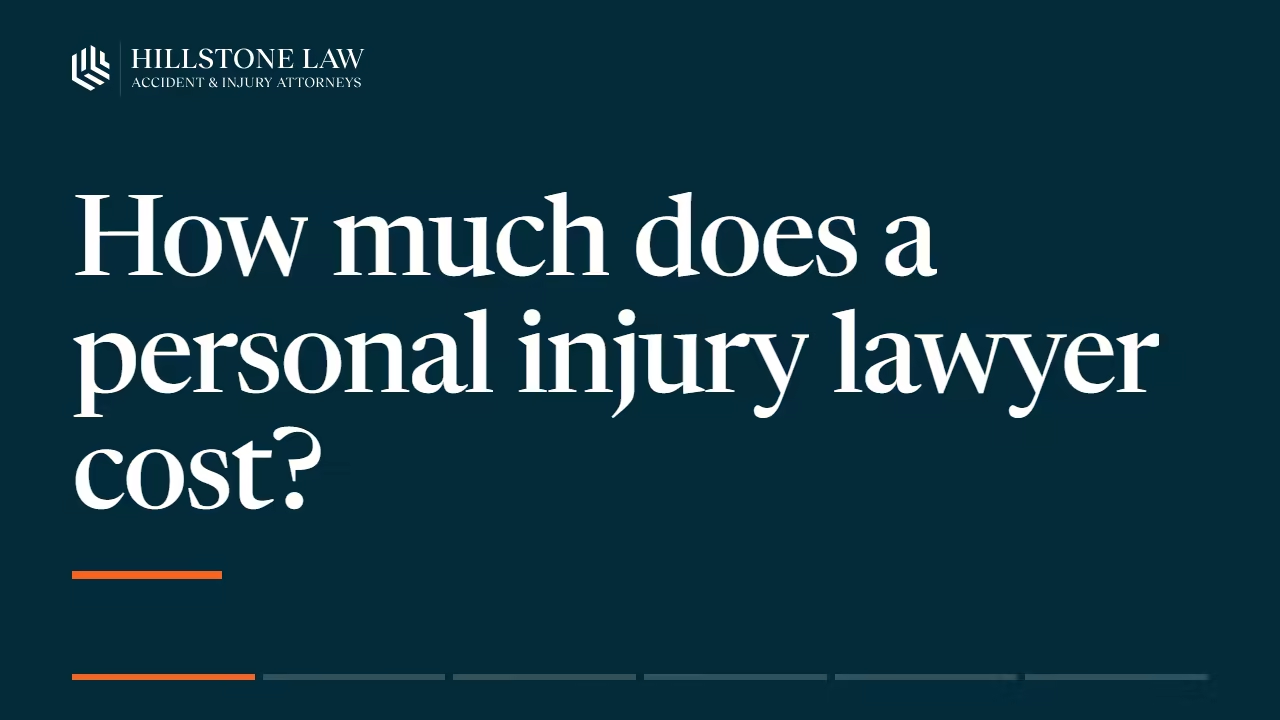
How much does a personal injury lawyer cost?
No fees unless you get paid. Our fee comes only from what we recover for you.
What you pay along the way: Nothing to hire us; Nothing while the case is open; Nothing by the hour.
A percentage of the recovery, in writing. You sign the agreement before we start. California law does not set the percentage. It is negotiable. Business and Professions Code 6147
Before you sign a settlement, we go through it line by line. The gross amount; Our fee; Each lien; What you receive.
Free consultation. Call and tell us what happened. (855) 691-1691 Hablamos español.
General information about California law, not legal advice for your situation.
Settlement offers that change the stakes
Either side can make a formal written offer to settle before trial (Code of Civil Procedure 998). These offers shift costs.
| Who made the offer | What happened at trial | What can follow |
|---|---|---|
| The defendant | The injured person refused it, then won less | No costs after the offer for the injured person; the defendant's costs from that point; part of the fees of the defense's expert witnesses, if the court orders it |
| The injured person | The defendant refused it, then the verdict was higher | The costs of the injured person's expert witnesses, if the court orders it; interest at 10% a year from the offer date (Civil Code 3291), except against a public entity |
A formal offer is one of the strongest tools before trial, and also one of the riskiest to ignore. Every one you receive needs careful advice.
Costs and what happens after the verdict
The winning party is entitled to recover its court costs (Code of Civil Procedure 1032), such as filing fees, jury fees and deposition transcripts. A court can also order a losing party to pay the other side's costs; before any lawsuit goes to trial, we explain in writing how that risk is handled in your case.
After a verdict, the losing side can ask the judge for a new trial or appeal. Many cases settle at this stage, because an appeal takes time and the judgment keeps earning interest. Once the judgment is final, the insurer pays up to its policy limit, and the lawyers collect the rest from any other source available.
How long a trial takes
Most injury trials last from a few days to two or three weeks, depending on the number of witnesses. The time from filing to trial varies by county and court calendar. Smaller cases, worth $35,000 or less, are limited civil cases with simpler procedures (Code of Civil Procedure 85).
Preparing with us
We prepare every case as if it will go to a jury: the witnesses, the expert witnesses, the medical proof and the exhibits. We prepare you for your deposition and for trial, and we give you our honest view of every offer. The decision to settle is always yours. We answer 24 hours a day, 7 days a week. Our intake team speaks Spanish. At your request, we can meet you at home or in the hospital.
The steps before a lawsuit are in how a personal injury lawsuit works and how the settlement process works. For what the jury weighs, read negligence, comparative fault, pain and suffering damages and what a case is worth; the California injury laws index lists every section on this page.
This is general information about California law, not legal advice for your situation.











