

When does an injury claim become a lawsuit?
Most injury claims start with the insurer of the person who caused the harm, not in court. A lawsuit is the next step when that insurer denies the claim, disputes fault, or offers less than the evidence supports. It is also the only step that stops the deadline: negotiating with an insurer does not pause the 2 years.
Filing changes how the other side behaves. Once a complaint is on file, the defense faces sworn testimony, court deadlines and the cost of preparing for trial, and the person or company being sued gets a lawyer, usually paid by its insurer. Some insurers make their first serious offer only after that happens.
A lawsuit is not always the right move. A small claim may belong in small claims court, where an individual can sue for up to $12,500 without a lawyer at the hearing (Code of Civil Procedure 116.221). A case asking for $35,000 or less is a "limited civil case", with simpler and cheaper procedures (Code of Civil Procedure 85). Anything larger is an unlimited civil case, which is where most serious injury lawsuits are heard.
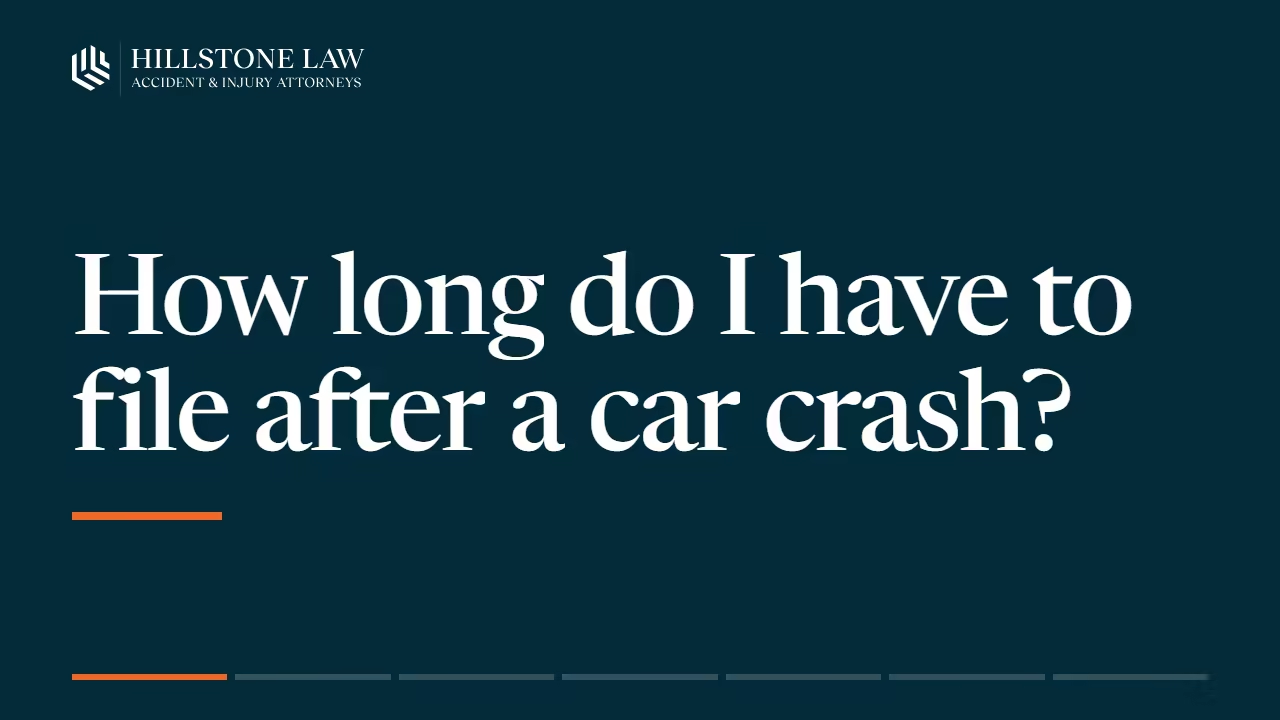
How long do I have to sue after a car crash in California?
Read the transcript
How long do I have to sue after a car crash in California?
How long do I have to file after a car crash?
2 years from the injury to file a lawsuit. That is the general deadline in California. Code of Civil Procedure 335.1
6 months if a public entity was involved. A city bus, a county truck, a dangerous public road: a written claim comes first. Government Code 911.2
The clocks that start at the crash: 10 days, dMV report, form SR-1; 6 months, claim against a public entity; 2 years, injury lawsuit; 3 years, vehicle damage only.
Negotiation does not stop the clock. If the claim is still open as the date approaches, the lawsuit must be filed to protect it.
Exceptions can shorten or extend these limits. A child was hurt; The at-fault driver died; A federal vehicle; Your own uninsured motorist claim.
Free consultation. Call and tell us what happened. (855) 691-1691 Hablamos español.
General information about California law, not legal advice for your situation.
Which deadlines decide whether you can still sue?
A court will usually dismiss a case filed after its deadline, however strong the facts. The 2-year rule is the one most people know, but several others come first or change the count.
| Deadline | What must happen | Law |
|---|---|---|
| 6 months from the injury | Written claim to a city, county, state agency or transit district | Government Code 911.2 |
| 1 year from the injury | Application to present a late claim to a public agency | Government Code 911.4 |
| 45 days after the claim | The agency's board acts on the claim | Government Code 912.4 |
| 6 months after a written rejection | Lawsuit against the agency | Government Code 945.6 |
| 2 years from the injury | Lawsuit for personal injury against a person or business | Code of Civil Procedure 335.1 |
| 3 years from the damage | Lawsuit for damage to property only | Code of Civil Procedure 338 |
| Paused until 18 | A child's own injury claim, except claims against public entities | Code of Civil Procedure 352 |
| 5 years from filing | The case must be brought to trial | Code of Civil Procedure 583.310 |
Method: Each period is the one the cited code section sets, counted from the injury unless the row names another starting point. 2026.
Source: California codes (leginfo).
Cite this: Deadlines that control a California injury lawsuit, Hillstone Law analysis of California codes (leginfo) data, 2026. https://hillstonelaw.com/guides/personal-injury-lawsuit-process/#data-lawsuit-deadlines-2026
Write your own date down today. If any public vehicle, road or building may be involved, treat the 6-month date as your real deadline. Our statute of limitations guide covers the less common periods.
What are the steps of a lawsuit, in order?
Every case is different, but filed injury cases move through the same stages, and knowing them makes the months less confusing.

| Stage | What happens | Your part |
|---|---|---|
| 1. Complaint | Your lawyer files the complaint in the superior court of the right county, naming every party at fault | Check that the facts it states are right |
| 2. Service and answer | Each defendant is formally served and files an answer, usually through a lawyer its insurer pays | Usually nothing |
| 3. Written discovery | Both sides send written questions and requests for documents, and subpoena records from others | Answer the questions with your lawyer, under oath |
| 4. Depositions | Witnesses, you included, answer questions under oath before a court reporter | Prepare with your lawyer and attend |
| 5. Defense medical exam | The defense may have a doctor of its choosing examine you | Attend, within the limits your lawyer sets |
| 6. Expert witnesses | Each side names the witnesses who will give opinions, such as doctors, economists and reconstruction engineers | Usually nothing |
| 7. Mediation | A neutral mediator helps both sides look for a settlement | Attend, listen and decide on offers |
| 8. Trial | A jury or judge hears the evidence and decides fault and damages | Attend and testify |
Method: General order of an unlimited civil injury case in a California superior court; the order and timing vary by county and by case. 2026.
Source: California codes (leginfo).
Cite this: The stages of a California injury lawsuit and your part in each, Hillstone Law analysis of California codes (leginfo) data, 2026. https://hillstonelaw.com/guides/personal-injury-lawsuit-process/#data-lawsuit-steps-2026
Settlement can happen at any point on that list, including the day before trial. When it does, the case ends with a signed release and a dismissal, as our settlement process guide explains.
What happens in discovery and at a deposition?
Discovery is the evidence-gathering stage, and it is usually the longest. Each side can demand documents, ask written questions that must be answered under oath, and take depositions of the other side, witnesses and treating doctors.

Your deposition is the most important day of discovery for you. A defense lawyer asks you questions about the accident, your injuries, your medical history and your life before and after, in a conference room or by video, with a court reporter recording every word. Your lawyer prepares you beforehand, sits beside you and can object to improper questions. Short, true answers serve you well, and "I don't remember" is a proper answer when it is the truth.
Expert witnesses come later. After the court sets the first trial date, any party may demand that all sides exchange, at the same time, the names of the expert witnesses they plan to call (Code of Civil Procedure 2034.210). In a case with lasting injuries, those expert witnesses often decide the outcome: a treating surgeon on future care, an economist on lost earning capacity, an engineer on how a crash happened.
Why do so many filed cases settle before trial?
Because by the end of discovery, both sides know most of the evidence, and the risk of trial becomes concrete. Mediation, where a neutral person shuttles between the two sides, is often where that risk turns into an agreement.
Formal offers add pressure. Once a case is filed, either side can serve a written offer under Code of Civil Procedure 998, and a party that refuses one and then does worse at trial pays a price in costs. The detail, including the interest rule that applies when an injured person's offer is beaten, is in our settlement process guide. What a case is worth, and why, is in what is my case worth.
Settling is always your decision, not your lawyer's. A good lawyer tells you plainly what the evidence supports and what the risk of trial looks like, and then lets you choose.
What happens at trial?
You have a right to a jury in a civil case (Code of Civil Procedure 631). Each side that wants a jury pays a $150 jury fee, which is not refunded. If both sides waive a jury, a judge decides instead.

A trial runs in a set order: choosing the jury, opening statements, the injured person's witnesses and evidence, the defense's witnesses, closing arguments, then the jury's deliberation. The jury decides two questions. First, who was at fault and in what share, because California reduces your recovery by any percentage of blame it assigns to you (see who is at fault). Second, what your losses are, both economic and non-economic.
The jury is not told whether the defendant carries insurance, and the law bars using that fact to prove negligence (Evidence Code 1155). After the verdict, either side may ask the judge for a new trial or appeal. Our personal injury trials guide walks through a trial day by day.
How much does a personal injury lawyer cost in California?
Read the transcript
How much does a personal injury lawyer cost in California?
How much does a personal injury lawyer cost?
No fees unless you get paid. Our fee comes only from what we recover for you.
What you pay along the way: Nothing to hire us; Nothing while the case is open; Nothing by the hour.
A percentage of the recovery, in writing. You sign the agreement before we start. California law does not set the percentage. It is negotiable. Business and Professions Code 6147
Before you sign a settlement, we go through it line by line. The gross amount; Our fee; Each lien; What you receive.
Free consultation. Call and tell us what happened. (855) 691-1691 Hablamos español.
General information about California law, not legal advice for your situation.
How long does a personal injury lawsuit take?
There is no fixed answer, because the pace depends on the injuries, the number of defendants and the court's calendar. A filed case with clear fault can resolve within months of the key depositions. A case with serious injuries, several defendants or a disputed cause often takes a year or more, and a trial date can be set further out in a busy county.
The law sets an outer limit: a case must be brought to trial within 5 years of being filed against the defendant (Code of Civil Procedure 583.310). In practice, the biggest driver of timing is medical: a case should not be valued, let alone tried, before doctors can describe your future. A catastrophic injury case takes longer for that reason, because future care is most of the claim.
What changes when you sue a public agency?
Suing a city, county, school district, the state or a transit agency follows its own track. Before any lawsuit, a written claim must be presented to the agency within 6 months of the injury (Government Code 911.2). The agency then has 45 days to act on it (Government Code 912.4). If it rejects the claim in writing, the lawsuit must follow within 6 months of that notice (Government Code 945.6).
This matters most in bus accidents with a public transit operator, crashes caused by a dangerous public road, and falls on public property. The pause for children in Code of Civil Procedure 352 does not apply to these claims, so a claim for a child hurt by a city bus is still due within 6 months. Missed it? A late-claim application may still be possible within 1 year (Government Code 911.4). Our guide to claims against a government entity has the details.
How does a lawsuit differ by type of case?
- Car accident lawsuits: fault is argued with the police report, video, photos and the vehicles themselves.
- Slip and fall lawsuits: the fight is usually over what the owner knew about the hazard, and when.
- Rideshare lawsuits: what the app showed at the moment of the crash decides which insurance applies.
- Motorcycle lawsuits: jury selection matters, because some jurors arrive with views about riders.
- Pedestrian accident lawsuits: crosswalk rules and the driver's duty of care frame the fault question.
- Wrongful death lawsuits: the law sets which family members may sue, starting with a spouse, a domestic partner and children (Code of Civil Procedure 377.60).
What should you do now?
- Write down the date of the injury and the deadline that applies, including the 6-month date if a public agency may be involved.
- Keep treating, and keep every bill, record and receipt in one place.
- Stay off social media about the case. The defense reads public posts and photos.
- Do not give a recorded statement to the other side's insurer before you have advice.
- Get a free case review well before the deadline, so evidence can be preserved while it still exists.
We investigate, present the claim, file suit when the insurer will not pay fairly, and prepare each case as if it will be tried. We answer 24 hours a day, 7 days a week, our intake team speaks Spanish, and at your request we can meet you at home or in the hospital.
This is general information about California law, not legal advice for your situation.











