

Before you call an insurer
A claim goes faster, and says less that can be used against you, when you have the facts in front of you before the first call. Gather these first:
- The date, time and exact place of the crash, including the direction each car was travelling.
- The other driver's details: name, phone, licence number, plate, insurer and policy number from the insurance card.
- The police report number and the name of the agency, or the incident number if no officer came.
- Your photos of both cars, the scene, the road and any injuries.
- Witnesses' names and numbers.
- Your own policy's declarations page, which lists the coverages you bought and their limits.
Write down the name and direct line of every adjuster you speak to, and the date. A short log of calls is the simplest protection you have when an insurer later says a conversation never happened.
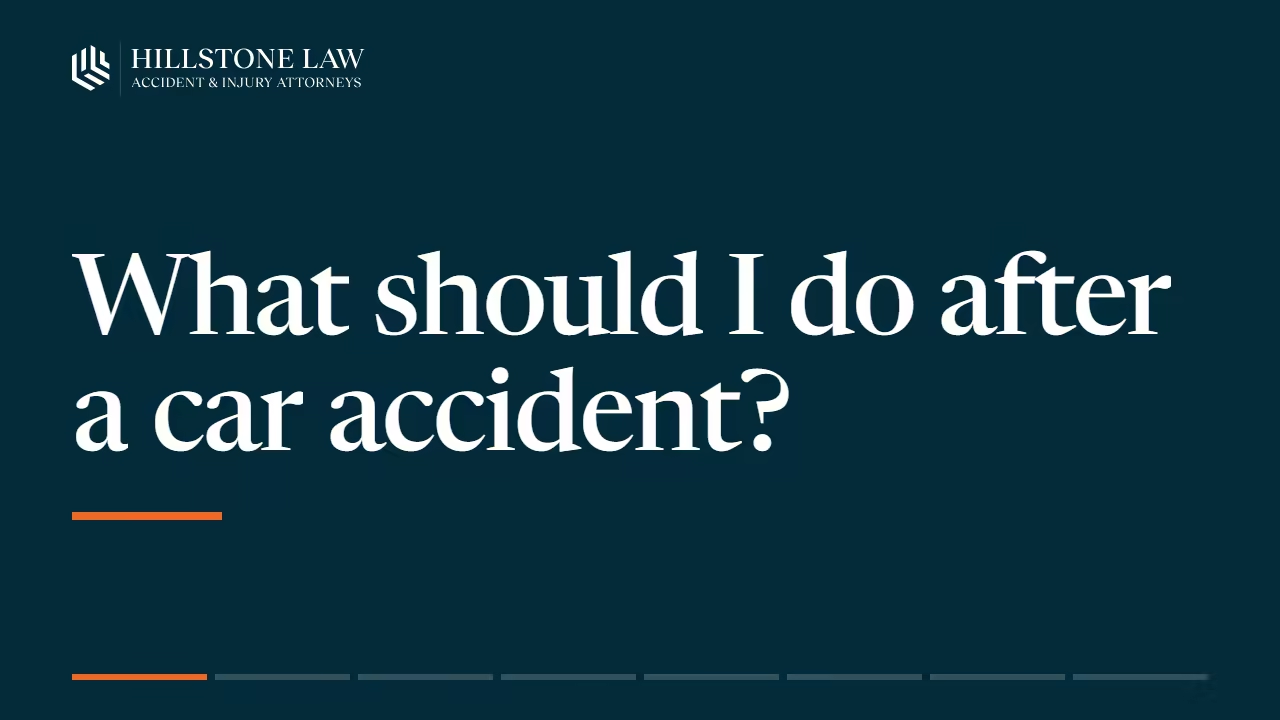
What should I do after a car accident in California?
Read the transcript
What should I do after a car accident in California?
What should I do after a car accident?
Stop. Check on everyone. Call 911 if anyone is hurt, even slightly.
Exchange information. Names, licence numbers, plates, insurers and policy numbers.
Photograph it. Find witnesses. The cars, the road, the signals, your injuries. Get names and phone numbers.
Say little about fault. Be polite, stick to facts, and do not guess about speed or distance.
See a doctor within days. Even if you feel mostly fine. Neck, back and head injuries often show up later.
10 days to report the crash to the DMV. When anyone was hurt, or damage was over $1,000. Form SR-1 · Vehicle Code 16000
Free consultation. Call and tell us what happened. (855) 691-1691 Hablamos español.
General information about California law, not legal advice for your situation.
The claims one crash can open
One crash can open several claims, with different insurers and different rules. Knowing which is which keeps you from accepting a payment on one that quietly closes another.
| Claim | Against | What it pays | When it applies |
|---|---|---|---|
| Liability claim (property damage) | The at-fault driver's insurer | Repair or value of your car, a rental, towing | The other driver was at fault and insured |
| Liability claim (bodily injury) | The at-fault driver's insurer | Medical bills, lost pay, pain and suffering | Same, up to that driver's policy limit |
| Collision | Your insurer | Your car, minus your deductible | You bought collision coverage; fault does not matter |
| Medical payments | Your insurer | Medical bills up to a small limit | You bought it; fault does not matter |
| Uninsured or underinsured motorist | Your insurer | Your injury losses the other driver cannot pay | The other driver had no insurance, too little, or fled |
| Uninsured motorist property damage | Your insurer | Your car, up to a small cap | The uninsured driver or plate is identified |
Method: Claim types as California auto policies usually provide them; minimum limits from Vehicle Code 16056, uninsured motorist rules from Insurance Code 11580.2 and uninsured motorist property damage from Insurance Code 11580.26, as read on leginfo in November 2026. 2026.
Source: California codes (leginfo).
Cite this: The insurance claims after one California car crash, Hillstone Law analysis of California codes (leginfo) data, 2026. https://hillstonelaw.com/how-to-file-california-car-accident-insurance-claim/#data-car-claim-types-2026
California's minimum liability limits for policies issued or renewed from 2025 are $30,000 for one person's injuries, $60,000 per crash, and $15,000 for property damage (Vehicle Code 16056). In a serious crash the other driver's policy is often too small, which is why your own coverages matter. See insurance policy limits.
Filing the claim, step by step
Step 1: Report the crash to your own insurer
Most policies require prompt notice of any crash, even one that was not your fault. Use the insurer's app, website or claims line. Give the date, place, the other driver's details and the police report number. Keep it factual and short, and ask which of your coverages apply: collision, medical payments, rental and uninsured motorist.
Step 2: Open a claim with the other driver's insurer
Call the insurer named on the other driver's insurance card, or file online; most insurers take a claim from someone who is not their customer. You will need the other driver's name, the policy number if you have it, the date and place, and a short description. Write down the claim number and the adjuster's direct line. Ask whether the insurer has accepted liability; until it does, it is only investigating.
Step 3: Handle the car first
Get a repair estimate, or two, and decide whether the repair goes through the other driver's insurer or your own collision coverage. The car is usually settled within weeks; the next sections explain how.
Step 4: File the DMV report if required
If anyone was hurt or killed, or property damage was over $1,000, each driver must file form SR-1 with the DMV within 10 days (Vehicle Code 16000). It is separate from any insurance claim, and filing it does not admit fault.
Step 5: Treat, and keep records
The injury claim is valued on medical records. Get care promptly and follow the plan. Keep every bill, receipt, pay stub and note of missed work in one folder.
Step 6: Send the injury claim when the picture is clear
Most injury claims are presented once treatment ends, or once doctors can say what future care is needed, as a written demand with the records and bills attached.
Step 7: Use your own coverage when the other side is not enough
If the other driver had no insurance, too little, or fled, your uninsured or underinsured motorist coverage may pay. It is included in California policies unless you deleted it in writing (Insurance Code 11580.2). Strict rules apply: settling with the at-fault driver without your insurer's written consent can cost you this coverage.
The car claim: repair, total loss and rental
The at-fault driver's insurer should pay for repairs, or for the value of the car if it is a total loss, plus a rental for a reasonable time. You choose the repair shop; the insurer may inspect the car first. If the other insurer is slow to accept liability, you can use your own collision coverage instead. Your insurer then recovers from the other side, and usually tries to recover your deductible too.
If the other driver had no insurance, two routes are open. Your collision coverage pays, minus your deductible. If you have no collision coverage but kept uninsured motorist property damage coverage, it pays the lesser of your car's actual cash value or $3,500, but only when the vehicles touched, the uninsured driver or the plate is identified, and you reported the crash to your insurer within 10 business days (Insurance Code 11580.26). Where both apply, collision pays first. See property damage claims.
Settling the car does not settle your injuries, as long as the paper you sign covers property damage only. Read the release line by line before you sign it.
The injury claim: when and how to send it
Sending the injury claim too early is the most common way people leave money on the table. A settlement is final, and costs that appear after it are yours.
The claim is usually sent as a written demand: a letter that sets out how the crash happened, why the other driver is responsible, every medical record and bill, proof of lost pay, photos, and an amount. The adjuster answers with an offer, usually lower, and the negotiation runs from there. Offers made during negotiation, and what is said in them, cannot be used in court to prove that a party was liable (Evidence Code 1152), which lets both sides talk frankly.
See how injury insurance claims work for the demand and negotiation in more detail.
Claims after a truck, bus or rideshare crash
Commercial crashes follow the same steps with a few differences that change who you file with and how fast.
- A commercial truck. The claim usually goes to the carrier's insurer, not the driver's personal policy. Note the company name and the numbers painted on the cab and trailer; logbooks, dashcam footage and engine data belong to the carrier and can disappear. See truck accidents.
- A city bus or other public vehicle. Before any lawsuit, a written government claim is due within 6 months (Government Code 911.2). An insurance claim alone does not meet that deadline. See bus accidents.
- An Uber or Lyft. Which policy pays depends on what the app showed at the moment of the crash: offline, waiting for a ride, or carrying a passenger. Screenshot the trip and report it in the app as well as to the insurers. See rideshare accidents.

How long do I have to sue after a car crash in California?
Read the transcript
How long do I have to sue after a car crash in California?
How long do I have to file after a car crash?
2 years from the injury to file a lawsuit. That is the general deadline in California. Code of Civil Procedure 335.1
6 months if a public entity was involved. A city bus, a county truck, a dangerous public road: a written claim comes first. Government Code 911.2
The clocks that start at the crash: 10 days, dMV report, form SR-1; 6 months, claim against a public entity; 2 years, injury lawsuit; 3 years, vehicle damage only.
Negotiation does not stop the clock. If the claim is still open as the date approaches, the lawsuit must be filed to protect it.
Exceptions can shorten or extend these limits. A child was hurt; The at-fault driver died; A federal vehicle; Your own uninsured motorist claim.
Free consultation. Call and tell us what happened. (855) 691-1691 Hablamos español.
General information about California law, not legal advice for your situation.
What to send, and what to hold back
Send: the police report number, photos, the repair estimate, medical bills and records related to the crash, and proof of missed pay.
Be careful with:
- Recorded statements to the other driver's insurer. You do not have to give one. What you say can be used to argue fault or to downplay your injury.
- Blanket medical authorizations. A form that opens your whole medical history goes beyond the crash. Send the records that relate to it instead.
- Releases. A release ends the claim for good. A general release signed during your first stay in hospital is presumed fraudulent under California law (Business and Professions Code 6152), but the safe course is not to sign one before you have advice.
- Social media. Photos of a hike or a party can be read as proof you were not hurt, whatever the day was really like.
Deadlines that run while the claim is open
An open claim does not stop any clock. These are the deadlines that matter most while you negotiate.
| Deadline | What is due | Law |
|---|---|---|
| 10 days | SR-1 report to the DMV, if anyone was hurt or damage was over $1,000 | Vehicle Code 16000 |
| 10 business days | Report to your insurer, for an uninsured motorist property damage claim | Insurance Code 11580.26 |
| 6 months | Written claim against a city, county, transit district or state agency | Government Code 911.2 |
| 2 years | Settle, sue or demand arbitration on an uninsured motorist claim | Insurance Code 11580.2 |
| 2 years | Lawsuit for your injuries | Code of Civil Procedure 335.1 |
Method: Each deadline is the one the cited California code section sets, counted from the day of the crash unless the row says otherwise, as read on leginfo in November 2026. 2026.
Source: California codes (leginfo).
Cite this: Deadlines that keep running during a California car insurance claim, Hillstone Law analysis of California codes (leginfo) data, 2026. https://hillstonelaw.com/how-to-file-california-car-accident-insurance-claim/#data-claim-deadlines-2026
Insurers know these dates. An adjuster who keeps asking for one more record as the 2-year mark approaches is not your timekeeper. See car accident deadlines.
If the claim is denied or stalls
Ask for the reason in writing, and send any evidence the insurer ignored. A denial by an insurer does not decide fault; a court can. You can also complain to the California Department of Insurance about how a claim is being handled.
If the at-fault insurer will not pay fairly, the remedy is a lawsuit against its driver, filed before the 2-year deadline. Many claims settle after suit is filed, once the insurer sees the case will go forward.
If you were uninsured yourself
California limits what an uninsured driver can claim. If you were driving your own car without insurance, you can still recover medical bills, lost pay and car damage from the driver at fault, but generally not pain and suffering (Civil Code 3333.4). Passengers are not affected by this rule. See car accident with no insurance.
When to get advice
Get advice before you give a statement to the other insurer, when you were hurt badly enough to need more than a check-up, when fault is disputed, when the other driver had little or no insurance, or when a deadline is near.
- We open and run every claim, with the other insurer and your own, so adjusters call us, not you.
- We send the demand with the full records once the medical picture is clear.
- We watch the deadlines, including the government claim and the lawsuit date.
- We negotiate liens and offers, so more of the settlement reaches you.
You pay no fees unless you get paid. We answer 24 hours a day, 7 days a week. Our intake team speaks Spanish. At your request, we can meet you at home or in the hospital. See do I need a lawyer after a car accident?
This is general information about California law, not legal advice for your situation.











