

What hurt you in the store?
Big-box stores, supermarkets and warehouse clubs know where shoppers get hurt, so most of them write down routines: floor walks on a schedule, spill kits at the end of aisles, rules for stocking above head height, cart corrals in the lot. A store claim asks whether the store followed its own routine, and whether the routine was reasonable.
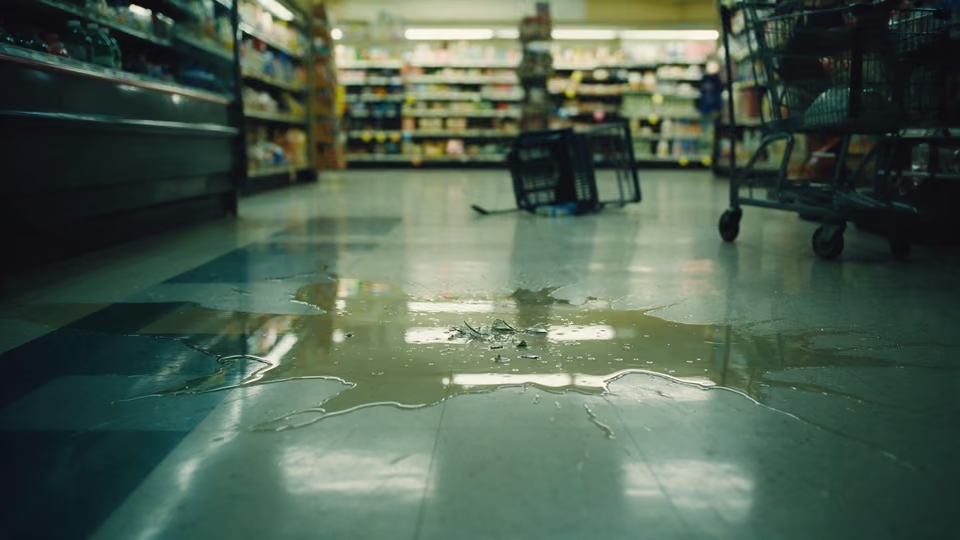
- A slip on a spill. Produce misters, a broken jar of sauce, a leaking freezer case, melted ice by the drink coolers, rain at the doors. The key fact is how long the spill sat and whether a scheduled floor walk should have found it.
- Merchandise that fell. Cases of water or paint stacked high, boxes pushed to the edge of a top shelf, a display another shopper knocked loose. A store that stocks above customers' heads has to stack so items do not come down on them.
- Something to trip on. A pallet left in the aisle during restocking, a torn mat at the entrance, the base of a display sticking out, a cord.
- Equipment. A pallet jack or forklift working in an open aisle, a line of carts pushed by an employee, a motorized cart.
- Doors and entrances. An automatic door that shuts on a person, a broken threshold, a step between the lot and the door.
- An animal. If another customer's dog bit you inside the store, the dog's owner is liable whether or not the dog had bitten before (Civil Code 3342).
Why the store's video matters more than anything you say
Stores usually keep camera footage only when someone asks them to. The ceiling camera over the aisle can show when the spill started, how many employees walked past it and whether anyone put out a cone. Without it, the case turns into your word against the store's.
| Store record | What it can prove | How long it may last |
|---|---|---|
| Aisle and entrance video | When the hazard appeared, who walked past, whether a cone was set out | Often recorded over within days or weeks unless saved |
| Floor-walk or sweep logs | Whether the aisle was checked on the store's own schedule | Store retention policy |
| Incident report written that day | The store's first account | Kept by the store; ask for a copy |
| Stocking records and shelf plans | How and when the shelf that fell was loaded | Store retention policy |
| Door, freezer and roof maintenance logs | Leaks and failures the store already knew about | Store and landlord retention policies |
| Receipt or loyalty-card record | That you were there, and when | Bank and store records last |
| The item that fell, your shoes and clothes | Physical proof | As long as you keep them |
A written request to keep the footage, sent to the store and its claims administrator in the first days, is the step that most often decides a store case. We send it the day we are hired.
The manager offered to pay your bills. Should you sign?
Be careful. Chains are often self-insured and use a claims administrator, whose adjuster may call within days to ask for a recorded statement and a medical authorization. An offer to pay a bill can come with a release that ends your whole claim, including injuries that have not shown up yet. Nothing the manager says at the scene binds the company, and you do not have to give a statement before you have advice.
| Question | California rule | Source |
|---|---|---|
| You were partly careless | Your recovery is reduced by your share of fault, never barred | Li v. Yellow Cab Co. (1975) 13 Cal.3d 804 |
| The store, the landlord and a vendor all share fault | Each pays your medical bills and lost wages in full, but pain and suffering only by its own share | Civil Code 1431.2 |
| You signed a release in the hospital | A general release signed during your first confinement, within 15 days, is presumed fraudulent | Business and Professions Code 6152 |
| What the store owed you | Ordinary care in the management of its property | Civil Code 1714 |
Method: Each row states the rule of the cited California statute or Supreme Court decision as it applies to a claim against a store; how it applies depends on the facts of each case. 2026.
Source: California codes (leginfo).
Cite this: California rules that decide how much a store injury claim pays, Hillstone Law analysis of California codes (leginfo) data, 2026. https://hillstonelaw.com/personal-injury/premises-liability/store-accidents/#data-store-claim-rules-2026
What if the store says you should have seen it?
Expect that argument. An adjuster may say the spill was obvious, that you were looking at a shelf or your phone, or that you climbed to reach an item. Shoppers are expected to look at merchandise; that is what a store asks them to do. Even when some blame is yours, it reduces your recovery rather than ending it, and the jury, not the adjuster, sets the percentages if the case goes to trial.
Can I get paid if I was partly at fault in California?
Read the transcript
Can I get paid if I was partly at fault in California?
Can I get paid if I was partly at fault?
Yes. California follows pure comparative fault.
A quarter to blame? You recover three quarters. A quarter: your share of fault; Three quarters: what you recover. The full value of your losses, less your own share.
Mostly at fault? You can still recover. Three quarters: your share of fault; A quarter: what you still recover. Li v. Yellow Cab Co. (1975) 13 Cal.3d 804
Who sets the percentages: Insurers argue your share in negotiation; At trial, the jury sets each person's share; The evidence: video, witnesses, the scene.
Do not argue fault with their insurer. What you say to adjusters is quoted back. Get advice first.
Free consultation. Call and tell us what happened. (855) 691-1691 Hablamos español.
General information about California law, not legal advice for your situation.
Who besides the store can be responsible?
- The landlord of the building, for roof leaks, broken stairs and structural defects it controls.
- A floor-care contractor whose waxing or wet-mopping left the floor slick.
- A vendor whose own merchandisers stocked the display that collapsed.
- The maker of a shelving unit, display or product that failed.
- A public agency, when the store sits on public property such as a transit station or airport; that claim needs a written filing within 6 months (Government Code 911.2).
| Who was hurt, or where | Deadline | Law |
|---|---|---|
| An adult, in a privately owned store | 2 years to file a lawsuit | Code of Civil Procedure 335.1 |
| A child | The 2 years generally start at age 18 | Code of Civil Procedure 352 |
| A shopper who died of the injury | The family's wrongful death claim, generally 2 years | Code of Civil Procedure 377.60, 335.1 |
| A store on public agency property | 6 months for a written claim to the agency | Government Code 911.2 |
Method: Each deadline is the one the cited California code section sets, counted from the day of the injury unless the row says otherwise. 2026.
Source: California codes (leginfo).
Cite this: Deadlines after an injury in a California store, Hillstone Law analysis of California codes (leginfo) data, 2026. https://hillstonelaw.com/personal-injury/premises-liability/store-accidents/#data-store-injury-deadlines-2026
Hurt while working at the store
Workers' compensation is a separate claim that Hillstone Law does not handle. If someone other than your employer caused your injury, you may also have an injury claim against them, and that is the claim we handle. In a store, that can be a vendor's stocker, a delivery driver or a cleaning contractor.
What to do after a store injury
- Get medical care, and tell the doctor exactly how you fell or what struck you.
- Photograph the spill, the shelf or the pallet before anyone cleans up, and the whole aisle around it.
- Ask for the manager, ask that an incident report be written, and note the manager's name.
- Get the names and numbers of shoppers who saw it.
- Keep the receipt, your shoes and anything that fell on you.
How Hillstone Law handles store claims
We send the footage-preservation letter to the store and its claims administrator first, then request the floor-walk logs and the incident report, and we handle every call from the adjuster. At your request, we can meet you at home or in the hospital. Our intake team speaks Spanish.
Results in premises cases
$720,000 settlement
Unsafe property injury.
More on the case results page.











