











Why a big rig case is not a car case
A tractor-trailer loaded to the legal limit can weigh many times more than the car it hits, and it needs far more road to stop. That physics explains why the injuries are worse, but it is not what changes the case. What changes the case is who stands behind the truck.
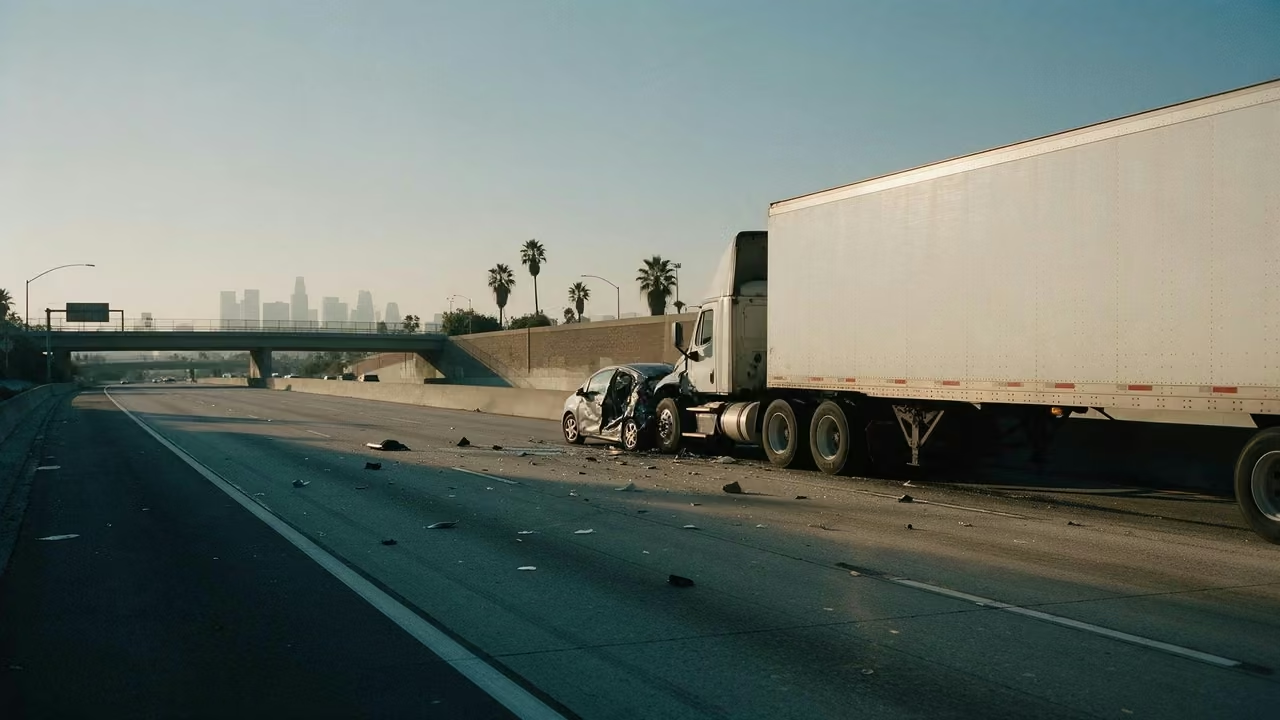
When two cars collide, there are usually two drivers and two insurers. A semi-truck runs under a motor carrier's operating authority, often pulls a trailer owned by someone else, carries freight loaded by a third company and may have been booked by a broker. Each of them can have its own insurer and its own lawyer, and each will try to place the blame on another. Federal safety rules apply to the carrier and the driver, and they create records that ordinary drivers never keep.
This page covers the tractor-trailers, semis and 18-wheelers that haul freight on California's freeways. Smaller vehicles have their own guides: delivery trucks, work trucks and commercial vehicles.
How often big rigs crash in California
| Year | Big-rig or heavy-truck crashes | With someone hurt or killed |
|---|---|---|
| 2022 | 19,488 | 5,090 |
| 2023 | 19,027 | 5,015 |
| 2024 | 19,209 | 4,939 |
Method: Crashes with a big rig or heavy truck among the vehicles, reported to the state crash database (CCRS), statewide, by year; the second column counts the crashes in which at least one person was injured or killed. Some local police do not fully report to CCRS, so each count is a floor. 2022–2024.
Source: California Highway Patrol (CCRS), read November 19, 2026.
Cite this: Big-rig and heavy-truck crashes reported in California, 2022-2024, Hillstone Law analysis of California Highway Patrol (CCRS) data, 2022–2024. https://hillstonelaw.com/personal-injury/truck-accidents/big-rig-truck-accident-attorneys/#data-truck-by-year-california-2022-2024
The federal count of deaths uses a different method, so it is shown on its own: in 2024, 394 people died in California crashes involving a large truck (federal FARS count, preliminary), and 358 of the state's fatal crashes that year involved one.
Most heavy-truck crashes happen where freight moves: the ports, the warehouse belt east of Los Angeles and the Central Valley corridors.
| County | Heavy-truck crashes, 2024 | With someone hurt or killed |
|---|---|---|
| Los Angeles | 5,537 | 1,235 |
| San Bernardino | 2,311 | 609 |
| Riverside | 1,660 | 435 |
| Alameda | 819 | 188 |
| Kern | 773 | 221 |
| San Joaquin | 772 | 216 |
Method: Crashes with a big rig or heavy truck among the vehicles, reported to the state crash database (CCRS) in 2024, by county where the crash happened; the six highest counties. Some local police do not fully report to CCRS, so each count is a floor. 2024.
Source: California Highway Patrol (CCRS), read November 19, 2026.
Cite this: California counties with the most big-rig and heavy-truck crashes, 2024, Hillstone Law analysis of California Highway Patrol (CCRS) data, 2024. https://hillstonelaw.com/personal-injury/truck-accidents/big-rig-truck-accident-attorneys/#data-truck-counties-california-2024
Who can be responsible for a big rig crash
Responsibility in a tractor-trailer case is a list, not a single name. We check each of these in every case:
- The driver, for speeding, fatigue, an unsafe lane change, distraction or impairment.
- The motor carrier, the company whose authority the truck runs under. It answers for a driver acting in the course of the job, and separately for its own failures: hiring a driver with a poor record, setting schedules that cannot be met within the hours rules, or skipping maintenance.
- The owner of the tractor or the trailer, when it is a leasing company or another business. An owner who lets someone drive is responsible for that driver's carelessness (Vehicle Code 17150), but where the driver is not the owner's employee or agent that liability is capped at $15,000 for one person and $30,000 for one accident (Vehicle Code 17151). That cap is why the carrier and its policy matter most.
- The shipper or loader, when an overweight or badly secured load shifted, spilled or made the trailer unstable.
- A freight broker, in some cases, when it chose a carrier it should have known was unsafe.
- The maker of a failed part, such as brakes, tyres or a coupling.
- A public agency, when road design or a missing sign contributed. A claim against an agency must be filed within 6 months (Government Code 911.2).
Naming every responsible company matters because of how California divides damages. Each defendant pays non-economic damages, such as pain and suffering, only in proportion to its own share of fault (Civil Code 1431.2). A company left out of the case is a share no one pays.
Punitive damages against a trucking company are possible but rare. The law requires proof that the company knew a driver was unfit and kept that driver on the road with conscious disregard for others, or approved the misconduct (Civil Code 3294).
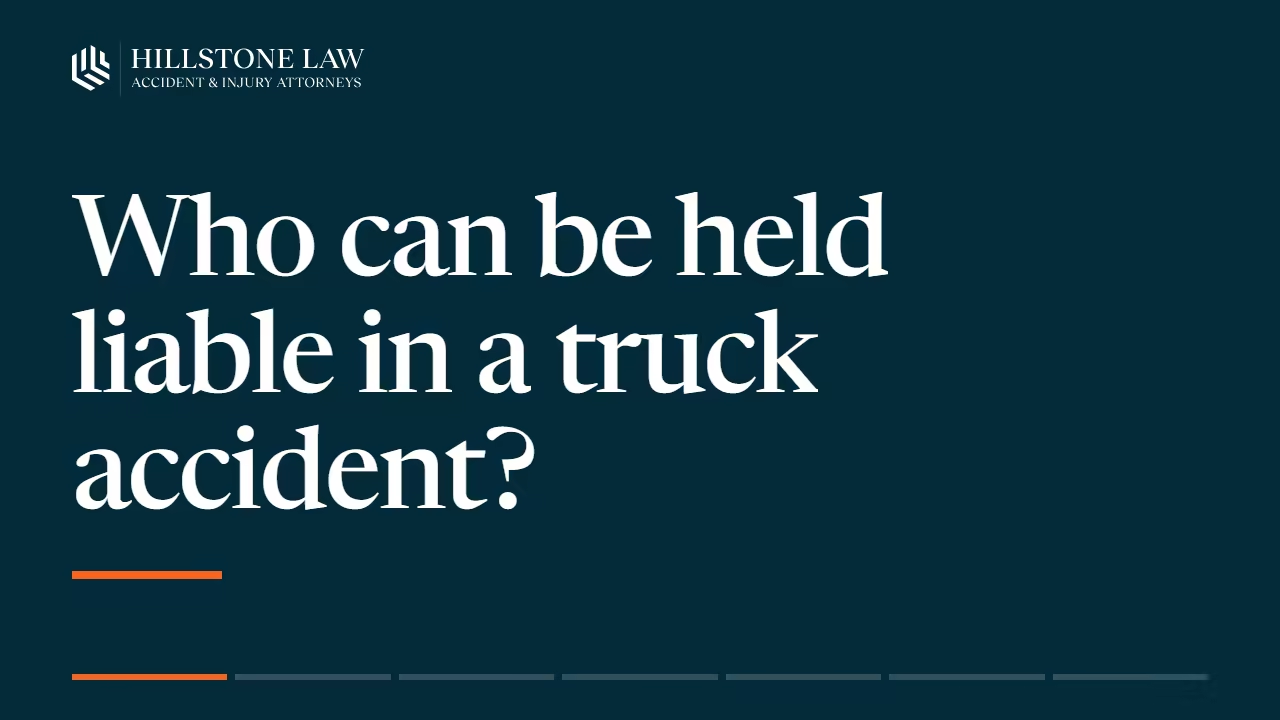
Who is liable after a truck crash, in under a minute.
Read the transcript
Who can be held liable in a truck accident in California?
Who can be held liable in a truck accident?
Often the trucking company, not only the driver. And its insurance is usually much larger than a car's.
Who can share the fault: The driver; The motor carrier; The broker or shipper; The loader; The maintenance shop or manufacturer; A public agency.
11 hours of driving at most, within 14 on duty. The federal limit for a property-carrying driver. 49 CFR 395.3
6 months the minimum a carrier must keep driver logs. After that, they may be gone. 49 CFR 395.8(k)
Photograph the cab door. The company name, USDOT number, trailer number and plate.
Free consultation. Call and tell us what happened. (855) 691-1691 Hablamos español.
General information about California law, not legal advice for your situation.
How much insurance stands behind a semi-truck
Commercial trucks carry far more insurance than cars, and federal rules set the floor for carriers that haul property between states:
| Carrier and cargo | Federal minimum (49 CFR 387.9) |
|---|---|
| For-hire carrier, general freight, vehicle 10,001 lb or more | $750,000 |
| Certain hazardous materials | up to $5,000,000 |
Method: The schedule of limits in 49 CFR 387.9 for for-hire carriers of property in interstate commerce. 2026.
Source: eCFR (49 CFR 387.9), read November 26, 2026.
Cite this: California: Federal minimum insurance for interstate property carriers, 49 CFR 387.9, as in force in 2026, Hillstone Law analysis of eCFR (49 CFR 387.9) data, 2026. https://hillstonelaw.com/personal-injury/truck-accidents/big-rig-truck-accident-attorneys/#data-truck-insurance-minimums-california-2026
Many carriers buy more than the minimum, and an excess or umbrella policy can sit on top. The trailer owner, the shipper and a broker may each have a separate policy. Finding every policy early shapes the whole case, because what can be collected depends on it. A truck that runs only inside California, or one owned by a public agency, is covered by different rules, which is one more reason to identify the carrier from the cab door, the trailer and the plates.
The records that decide a big rig case
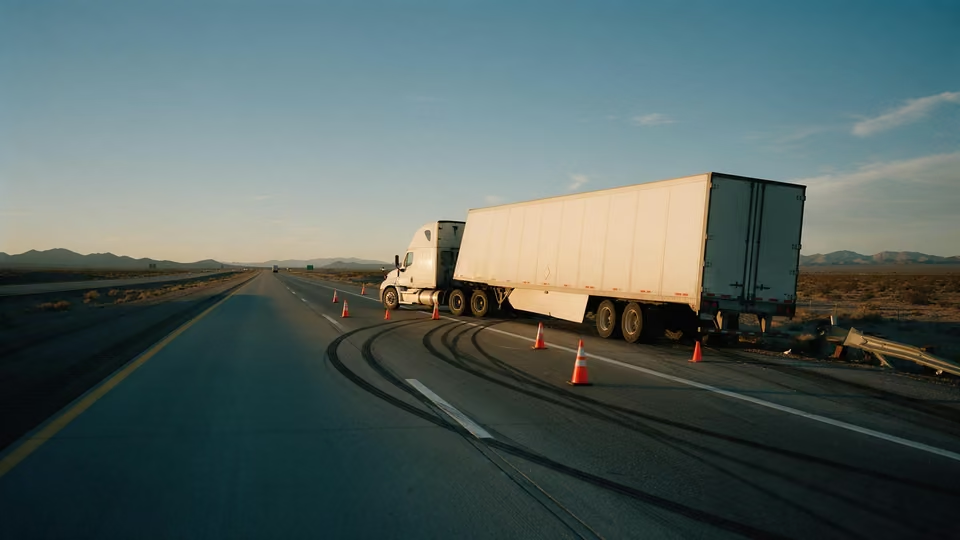
Federal rules limit how long a property-carrying driver may work: at most 11 hours of driving inside a 14-hour window, after 10 consecutive hours off duty (49 CFR 395.3). Fatigue is a common thread in serious truck crashes, and these limits are where the proof starts.
| Record | What it can show | How long it may last |
|---|---|---|
| Records of duty status (logbook or electronic logging device) and supporting documents | Hours driven and rest taken; whether the 11-hour and 14-hour limits were broken | Carriers must keep them at least 6 months (49 CFR 395.8) |
| Engine control module and event data | Speed, braking, throttle and cruise control in the seconds before impact | Can be overwritten when the truck goes back into service |
| Forward and driver-facing cameras, telematics | The road ahead and what the driver was doing | Often kept only days or weeks |
| Dispatch messages and delivery appointments | Whether the schedule pushed the driver past the rules | The carrier's retention policy |
| Maintenance and inspection reports | Brakes, tyres, lights and defects drivers reported | The carrier's retention policy |
| Driver qualification file | Licence, medical card, past violations, drug and alcohol tests | The carrier's retention policy |
| The tractor and trailer themselves | Brake condition, load securement, lighting | Repaired or sold quickly |
The step that protects this evidence is a written preservation demand to the carrier, the trailer owner and anyone else who may hold records, sent as soon as they are known. It puts each company on notice that destroying records would be held against it. We send it in the first days of a case.
What the trucking company does in the first hours
Many carriers follow a crash-response routine: a call to the insurer, an adjuster or investigator sent to the scene, and photographs and statements gathered for the company's defence. The injured person, meanwhile, is usually in an emergency room. That gap between what the carrier knows on day one and what you know is the reason to act quickly.
- Get medical care. Injuries from a truck crash are often worse than they first feel.
- Record the truck. The carrier's name and the numbers on the cab door, the trailer number and both plates. Photograph them if you can.
- Get the report number. Freeway truck crashes are usually handled by the CHP.
- Photograph the scene. The vehicles, skid marks, the load and your injuries.
- Do not give the carrier a statement. Its insurer or investigator may arrive within hours; you do not owe them one, and you should not sign what they bring.
- Note the deadline. A lawsuit must generally be filed within 2 years of the injury (Code of Civil Procedure 335.1).
If you were partly at fault
California splits fault rather than barring a claim. If a jury finds you partly responsible, your recovery is reduced by your share but not lost (Li v. Yellow Cab Co. (1975) 13 Cal.3d 804). Trucking companies often argue that the car cut in front of the rig or stopped short. The truck's own engine data and cameras often answer that argument, which is one more reason to secure them early.
How we work a tractor-trailer case
Our lawyers are available 24 hours a day, 7 days a week, so the preservation demand can go out while the logs and the engine data still exist. At your request, we can meet you at home or in the hospital. Our whole team speaks Spanish. From 16 offices across California we identify the carrier, the trailer owner and every other company that touched the load, and bring each one's policy into the claim.
Results
One result below is a truck case; the other is a case where an employer was held responsible for its driver.
$2.75 million
A truck hit their car.
$4,725,000 settlement
Motorcycle crash, Los Angeles County, 2025 · Obtained with co-counsel.
More on the case results page.

